Every time I hear, “We’re losing deals because our prices are too high,” I have the same reaction: Yeah maybe…but probably not.
In most B2B environments, price gets blamed for a whole bunch of sins it didn’t actually commit. And more often than not, the real culprit is sitting upstream in the way the offer itself has been constructed…or more accurately, not constructed.
You see, when you step back and look at how offerings actually come together in many B2B environments, it’s not exactly a masterpiece of intentional design. It’s more like a group project where no one meets or even compares notes until the day of the presentation.
As we discuss in the Pricing and Offer Design training session, offer design in B2B tends to suffer from a number of structural deficiencies…
1. Offers Aren’t Coordinated
The product team does its own thing. The marketing team does different things. Finance and legal are crafting terms and conditions in a vacuum. Salespeople are saying and promising all sorts of things in the field. And service and support teams are trying to juggle different service-level commitments after the fact.
Somewhere along the line, this mess gets thrown over the fence to the pricing team. And beyond some budgetary, high-low price estimates the product team used in their Monte Carlo simulations, there’s not much to work with. But still, we do our best to come up with some usable pricing structure and guidance.
All of these different things are happening…they’re getting checked off the list…but they’re happening in separate silos. And of course, each silo has its own priorities, incentives, skill levels, capabilities, accountabilities, and so on.
2. Offerings Aren’t Holistic
In theory, an offering is “the total package” of everything the buyer gets, what they’re going pay, and under what terms and conditions. Everything in the offering is viewed in relation to…and in the context of…everything else in the offering.
But what does the buyer end up seeing in too many cases? A patchwork…a hodgepodge…a mishmash of disparate pieces and parts that…thanks to the silos…weren’t actually designed to work together in the first place.
And here’s the real kicker…your buyer is often the first and only person to actually evaluate the whole end-to-end, top-to-bottom package. Not the contributing teams. Not management. The buyer.
So the buyer is being forced to make sense of all this…while at the same time trying to decide whether to give you money and how much.
3. Offers Are Not Strategic
Even when companies do attempt to “design” offers intentionally, they will too often default to a generic, one-size-fits-all approach. Same product and service bundle. Same structure. Same options. Same feature sets. Same messaging.
I get it…tailoring offers to different segments feels hard. It requires some real insight into what different segments of buyers actually care about, how they prioritize value, and how the relevant alternatives stack up. So instead of doing the homework, it’s easier to pull together a somewhat generic offer that’s technically coordinated and holistic…but not particularly compelling to anyone.
And then we act surprised when buyers push back on our prices.
But when the offer isn’t speaking to what specific buyers actually value…and isn’t making the competitive differentiators obvious…why wouldn’t the buyers push back on the prices? After all, the prices are likely to seem just as generic and arbitrary as everything else, right?
So…Is It Really the Price?
Very often, what looks like a pricing problem is actually an offer design problem in disguise. Because when offers are internally coordinated, holistically constructed, and strategically aligned something interesting happens…
Pricing pressure starts to ease.
Not because buyers suddenly love paying more, but because the offer itself is doing more of the heavy lifting. It’s making the evaluation easy. It’s giving them what they want. It’s framing the value. It’s guiding the comparisons. It’s justifying the price.
In other words, it’s doing its job. And if your offers aren’t doing that job today, you can keep arguing about price…or you can fix the real problem.
Pricing and Offer Design

Well-crafted offers justify the price, drive preference, disarm objections, and anchor negotiations before they begin. But how do we overcome the challenges that are unique to B2B environments?
Communicating Value Over Price
How do you know whether your value messaging is good, bad, weak, or strong? And how do you ensure that the value of your offerings is being communicated as effectively as it really could and should be?
Better Product Management for Better Pricing
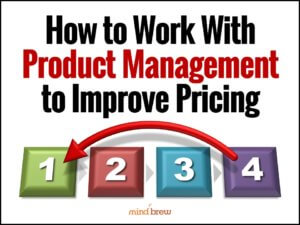
In this on-demand webinar, learn how leading pricing teams are influencing the pre-market decisions that can increase pricing pressure and limit the prices you can command in the market.