Rumor has it that there is a school speed limit sign somewhere in Georgia that lists 6 times a day when the speed limit is in force. If the Internet can be believed, it looks like this:
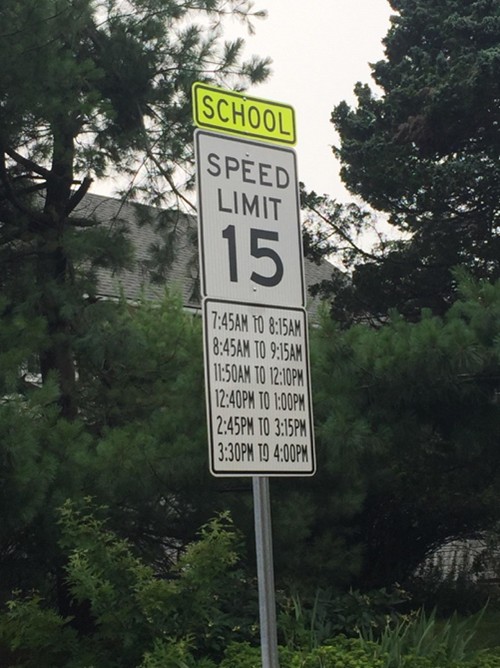
The obvious problem with this sign is that it’s impossible to read and process all these time periods, even if you’re only going 15 mph.
It actually misses the entire point of a school speed limit sign. The goal is to keep children safe when they are around, while also keeping traffic moving when the risk is low. But with a sign like this, you will have two categories of drivers: cautious drivers who always drive slow and more aggressive drivers who always drive fast. As a result, the kids won’t ever really be safe and traffic won’t ever keep moving.
Really, the only “good” thing that will happen as a result of this sign is that the city will have the opportunity to make some money off tickets to speeding drivers.
It’s a stupid sign.
So why do we design pricing processes that are just like it?
The danger of pricing complexity
A lot of pricing teams create elaborate pricing matrices, detailed rulebooks, and multi-page guidance documents that lay out all the possible exceptions and variations to their pricing structure. And then they wonder why reps aren’t following the guidelines. For example, we have heard pricing teams tell sales:
- “Here’s a complicated pricing matrix—use it to figure out how to quote.”
- “Remember to check the customer segment before quoting.”
- “Make sure you account for volume, region, competitive situation, and relationship status.”
- “Don’t forget to get approval if you go beyond these thresholds.”
Just like a busy driver, the salespeople don’t have the time to stop and read a lot of complex material while quoting. They are in a hurry to get on to the next sale.
So they’ll just wing it—offering a price that is too low if they are cautious and a price that is too high if they are more aggressive.
Introduce a forcing function
Instead of relying on the sales team to look things up, we recommend finding ways to encourage or even force them to do the right thing.
User-centric design expert Don Norman calls this a “forcing function” in his book The Design of Everyday Things. He points out that we actually experience forcing functions all the time. For example, your microwave won’t turn on unless the door is closed. Your car won’t shift out of park unless your foot is on the brake. Your word processing program asks, “Do you want to save this document?” when you try to close without saving. These things are idiot-proof because they make it really hard or even impossible to do the wrong thing.
You can introduce similar “safety” mechanisms into your pricing processes:
- Quoting tools that automatically surface the right price based on customer data (instead of requiring reps to look it up)
- Applications where the profitable option is presented as the default (instead of making reps choose from many options)
- Guided selling workflows that walk reps through the right questions (instead of assuming they’ll remember to ask)
- Price floors built into the system (instead of hoping reps remember the policy)
- Approval workflows that trigger before the quote goes out (instead of after the damage is done)
The point is to design your processes so that it’s easier to do the right thing than to do the wrong thing. We cover this idea in more detail in Delivering No-Brainer Pricing Guidance.
It’s easy to see that the school zone in the photo above would be much better served by a sign that blinks when the limit is in force or even one that just says the limit applies “when children are present.” It’s time to consider how you could eliminate some text from your sales guidance and deliver what is essentially a big flashing light that makes the desired behavior very clear.
Delivering No-Brainer Pricing Guidance
While equipping sales reps with accurate pricing guidance is a priority for many, it's hard to get right. In this session, learn seven key ingredients to deliver guidance your salespeople will actually use.