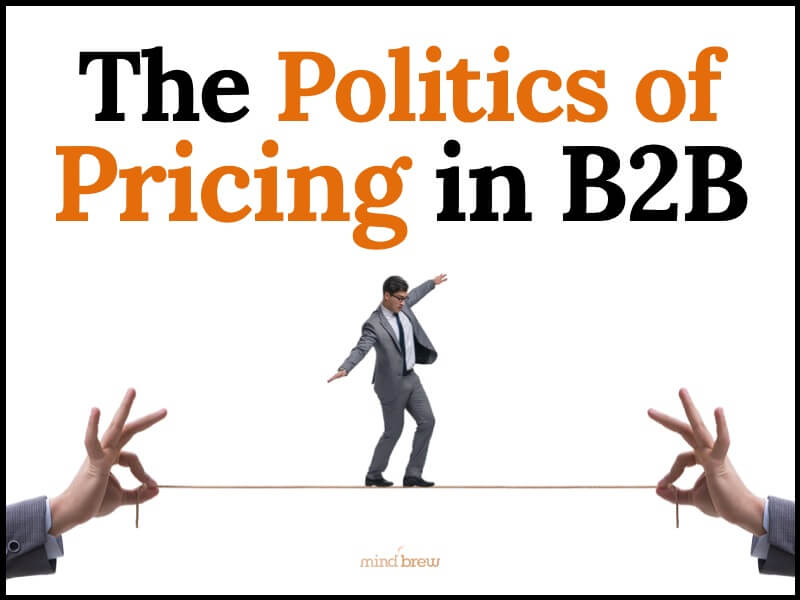
Do you sometimes feel like you are the only one in your company who actually wants to make money?
We frequently hear from pricing teams that some of the fiercest pricing battles that they face don’t involve the customer at all. Instead, they find themselves having to defend their decisions to set profitable prices within their own organizations. It’s highly counterintuitive, but many B2B organizations have a weird dynamic where many of the pricing stakeholders actually want to charge lower prices. As a result, pricing professionals often find themselves arguing with sales teams or even management about what to charge for their products.
Why does this happen? Here are four common reasons:
- High sales quotas. Our research reveals that 76% of B2B sales teams are facing higher sales quotas. That pressure to meet the quota puts salespeople into a mindset where they will do almost anything to close a deal. If that means cutting into margins by 1% or 5% or 10% or more—so be it. They will argue internally for lower prices—and/or cave to the slightest bit of negotiating pressure—if they think that will make them more likely to meet their numbers.
- Price as a scapegoat. When salespeople are entering the reason why they lost a deal into the CRM system, they cite “price” more than anything else. And in fact, the customer may have told them that price was the reason why they went with a competitor. Of course, when researchers take a deeper dive into buying motivations, price isn’t nearly as big a factor. But that doesn’t stop the perception that price is what loses deals—and the corollary that if you get the right price you will always win deals. Salespeople want to win, so they argue for a lower price.
- Focus on revenue. When management presents their growth targets to the rest of the organization, they often use only revenue numbers. As a result, the rest of the organization gets the message that revenue is more important than margin. Of course, that’s not the message the executives mean to send. They don’t want growth at any cost! But that nuance is difficult to communicate and gets lost in translation. Unfortunately, if the team is too focused on revenue, they will fight for lower prices as a way to achieve those goals.
- Precedent. In organizations that haven’t been actively managing price using modern, data-driven methods, it can be hard to convince stakeholders that your methods actually work. They might be so used to setting prices based on what they think something should cost that they resist what your scientific analysis shows. They will fight to maintain comfort of the status quo rather than facing the fear associated with raising prices.
If you recognize your organization in one or more of these descriptions, you are on your way toward winning these internal battles. Diagnosing the problem is always the first step.
But after that, you need to know how to address the problem. For that, check out the webinar How to Defend Your Prices. It offers some battle-tested strategies and tactics that will help you better equip your pricing team for your next internal fight.
How to Defend Your Prices
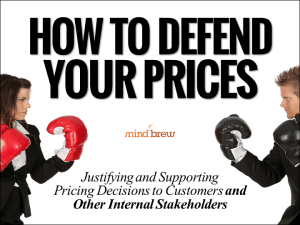
In B2B environments, you're sometimes facing a battle on two fronts: With customers and prospects, and with others inside your own company. In this on-demand webinar, learn about effective strategies and tactics for defending your prices internally and externally.