Near the beginning of the year feels like a great time to address a fairly common value-based pricing concern that comes through the subscriber Help Desk in various forms. I’m paraphrasing, of course, but the general theme is something like this…
“We’d like to lean more into value-based pricing and negotiation. But we’re concerned about the accuracy of our value estimates. What if they’re wrong?”
Sometimes this will be framed as a technical concern about the assumptions, the equations, or the quality of the underlying data. Other times, however, it’s more of a human or interpersonal concern related to credibility and trust.
What if a prospective buyer pushes back? What if they strongly disagree? What if they think we’re overstating things in a big way? Won’t we end up looking foolish? Won’t they see us as being manipulative? Or maybe even a bit slimy?
The overall concern is certainly understandable. And it’s big reason so many teams never quite do what they say they want to do with respect to value-based pricing and negotiation.
You see, when pricing and sales teams start working with value estimates, they tend to get very wrapped up in the mechanics—the value drivers and assumptions, the formulas and equations, the models and calculators, and so on. And they’re constantly asking whether it’s right, whether it’s relevant, whether it’s defensible, and whether it’s really “tight enough” to put in front of a buyer.
Of course, these are all great questions to ask in the development phase.
But what all-too-often happens next is that the teams get so hung up on precision…and not being the slightest bit “wrong”…that the value estimates either get toned down to the point they can have no influence whatsoever on willingness-to-pay or they end up getting shelved altogether, never again seeing the light of day.
The reality is that value estimates are always going to be wrong to some degree.
After all, differential value estimates are not accounting numbers that you can “tie out” and audit down to the penny. They’re just an attempt to describe the potential economic impacts in a complex and dynamic commercial environment. So no matter how diligent and thorough your approach, your value estimates are still just estimates…and as such, they’re always going to be wrong.
Besides, focusing too heavily on tactical accuracy and precision misses the much larger strategic point of the entire exercise…
The purpose of a differential value estimate is not to produce a perfect answer. It’s to provide a springboard or platform for talking about the impacts, outcomes, and tradeoffs in a structured and advantageous way. It’s not a scientific proof; it’s a tool for enabling productive conversations.
Once you see it this way, you stop worrying quite so much about whether the number is exactly “right” and you start paying more attention to the quality and efficacy of the resulting conversations.
Imagine sitting with a potential buyer and walking through how your solution will reduce their costs, boost their revenues, lower their risks, and/or improve their productivity. Once the value-drivers have been established, you present your all-in value estimate of $150,000 in annual benefit. At this point, the buyer pushes back strongly, saying that your numbers are way off, and insisting that the annual benefit is no more than $110,000…maybe $115,000…tops.
Is your value estimate wrong? Almost certainly! But guess what? Instead of talking about price, you’re now negotiating value.
You’re now talking about how much economic impact will be created, how confident the buyer is in that impact, and ultimately, how that value should be shared. And that’s a very different conversation than haggling over discounts off a list price with little connection to the benefits a buyer is actually seeking.
Ironically, having your value estimates challenged makes this all work better.
When a buyer questions an assumption and you say, “That’s fair…let’s talk about it,” you’re not weakening your position; you’re strengthening it. You’re demonstrating that it’s an earnest effort to better understand their business and not just a sales pitch wrapped in a spreadsheet or online calculator.
Their objections tell you what they believe, what they measure, and what actually matters to them. Along the way, their feedback makes your value case more grounded and realistic. And when all is said and done, they’ll view your case as being far more credible…because they helped craft it!
So…by all means, do the development work to make your estimates as relevant and accurate as possible. But you should always remember that it’s not really about the calculations…it’s about the conversations around the calculations.
The Fundamentals of Value-Based Pricing
Value-based pricing is like any other business practice in that most of the power comes from mastering the fundamentals. In this on-demand webinar, learn the core concepts and essential processes that generate the most bang for the buck.
Leveraging Your Multidimensional Value
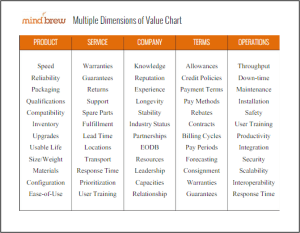
What are the dimensions of value that matter most to buyers? Which specific value drivers should you be prioritizing? And how do we incorporate them into our pricing and value propositions?
Getting Sales To Sell the Value

Your offerings deliver greater value. But at the slightest pushback from a buyer, your salespeople give in and start discounting that value away. In this webinar, we explore how to change this dynamic for good.