If you’ve been following the PricingBrew Journal for any length of time, you’ve likely noticed the constant drumbeat about price segmentation. When it comes to improving pricing performance, there are few things as powerful and foundational as having a real price segmentation model. So every chance we get, we try to drive that point home…because it really is that important.
Constructed properly, a real price segmentation model will describe the situations and circumstances under which customers have higher or lower price sensitivity or willingness to pay. As a result, a sound price segmentation model is like a map that shows you where you can capture higher prices and where you can’t.
Of course, the first order of business is to start charging higher prices in those segments that clearly have a higher willingness to pay. That’s fairly obvious and can pay significant dividends in fairly short order.
But for segments where willingness to pay is lower, you often find yourself asking, “How can we get them to pay more?” And of course, there are things you can do in response. For example, shoring up your differential value arguments in those segments might improve perceptions and boost willingness to pay.
However, this may not be the most powerful question you can ask…
Very often, we’re much better off asking, “How do we get even more business in the segments with higher willingness to pay?” Rather than shoring up your weaknesses, this question speaks to feeding your strengths—which can be a lot easier, more cost effective, and far more strategic.
And here again, there are things you can do in response. For example, you can identify what those high-performing segments have in common. Are there certain types of customers involved? Certain products? Particular applications or use cases? Your sales and marketing teams can then use that criteria to target, attract, and acquire even more of those specific opportunities.
Doing more business in the segments that are willing to pay more? Boosting top-line revenues and bottom-line profits at the same time? Now, that’s the kind of double-whammy that can make even the most stoic CFO crack a smile.
And robust price segmentation is what makes these kinds of strategic choices possible. So get on it — before the next drumbeat 🙂
The Fundamentals of Price Segmentation
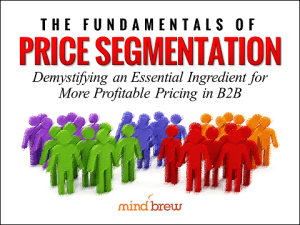
In this recorded training seminar, we explain the concept of price segmentation and why it's such a powerful and important tool. We explore the essential process and even walk through a step-by-step exercise, building an example price segmentation model from scratch.
The Price Segmentation Self-Assessment
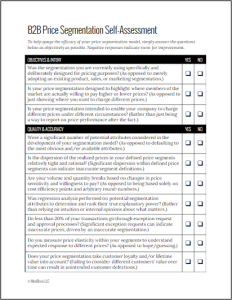
Simply answer the questions in this self-assessment (objectively) to gauge the likely quality, accuracy, and efficacy of your price segmentation model. You can assess overall quality, as well as pinpoint specific opportunities for improvement.
How to Explain Price Segmentation to Others

As powerful as it is, price segmentation can sometimes be difficult for people outside of pricing to understand. This tutorial simplifies the concepts so that just about anyone can understand this important and foundational concept.