Writer H.P. Lovecraft once said, “The oldest and strongest emotion of mankind is fear, and the oldest and strongest kind of fear is fear of the unknown.”
Fear of the unknown often rears its ugly head when it comes time to raise prices or even just change the processes for setting prices. It feels incredibly risky to take an action that seems like it might lead to a loss in sales—especially for salespeople. Even though they understand all the benefits that will come from increased margins, a pricing increase can seem like a bad idea. People often find it hard to see the actual losses from money left on the table by not optimizing prices—and all too easy to see the potential losses from imagined lost sales that may never materialize.
If your team has run into this problem, you’re not alone.
The perceived risk of a pricing change can make it very hard for pricing teams to gain traction with any of their initiatives. No matter what you propose, you may find that someone in the company is arguing vehemently in favor of maintaining the status quo.
So what can you do about it?
One of the best ways to push forward an initiative in a risk-averse environment is to propose a pilot program. This gives the pricing team the opportunity to prove out their ideas on a small scale before rolling them out more broadly—to “nail it and scale it,” if you will.
The pilot program approach has at least five benefits:
- It provides some cover against a large-scale failure. If things don’t work out as expected, the team can learn from the experience without catastrophic results.
- It gives management an ideal compromise. They can balance their desire to maximize margins with their desire to minimize risk.
- It allows the pricing team to iron out any flaws in their plan before scaling it out to the entire organization.
- It lets the broader team know what to expect if everything works out. And it gives them confidence that the new plan has been adequately tested.
- It provides some great data for your team. There’s nothing quite like being able to show management the additional margin they could have been capturing if the project were implemented more widely.
If you’re ready to give a pilot program a try, check out the webinar on Pricing Pilot Programs. It explains how to design your pilot program so that it meets your needs, as well as how to sell the pilot program internally. It also offer tips on how to measure success or failure and how to successfully scale up after the pilot ends.
People are always going to be afraid of the unknown. But if you can introduce them to just a small piece of the unknown, it becomes a lot less scary. And over time, an unknown risk becomes a known benefit, and that will make it a little bit easier to get buy-in for your next initiative.
Pricing Pilot Programs
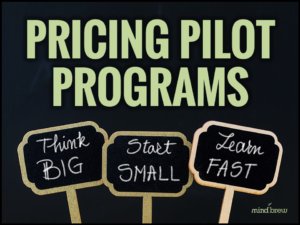
How do you get your company to accept new pricing approaches while maximizing your odd of success? In this session, learn how to leverage pilot programs and in-market trials to accelerate your progress.