When describing her management philosophy, former Yahoo CEO Marissa Mayer explained, “You basically say, ‘This is the direction; this is where we’re heading,’ and then it’s my job to get everything else out of the way. All the other things that can become a distraction keep us from executing well. Get those out of the way, because the team ultimately needs to run in that direction and execute well.”
Regardless of how her tenure at Yahoo turned out, Mayer’s insights into the importance of focus and avoiding distraction are noteworthy. They especially ring true for pricing, where it’s all too easy to get carried away by distractions.
You see, to be good at pricing, you really need to focus on one key question:
“When, where, and why are different groups of customers willing to pay different prices?”
This is undoubtedly the most powerful question in pricing. Only after you know the answer should you move on to the other two critically important questions for pricing:
What are those different prices?
and
How will we get these prices to the sales team?
But far too many B2B pricing teams never get around to answering those questions because they get distracted by other things. They’re wrapped up in finding the answers to other questions, like
- How do we react faster to cost increases?
- How can we speed up quote turnaround time?
- How should we respond to this competitor’s price?
All those questions seem really important. But that’s just because they are time-sensitive. It’s always a mistake—albeit a very common one—to confuse urgency for importance.
Think of it this way: if you are parenting a toddler, at times it is going to be urgent to do a diaper change. But diaper changes are far less important than potty training. It would be a mistake to focus all your time and energy on researching and perfecting techniques for the fastest, most effective diaper changes when you could instead focus on a strategy for eliminating the need to do those diaper changes at all.
So if you are facing one of those urgent questions—say, for example, your biggest competitor has dropped pricing by 20% across the board—by all means, do the diaper change. Handle the issue, but do it quickly and without a lot of fuss.
Then, make some time to focus on the most powerful question in pricing. When you have a good pricing segmentation in place, you’ll find that you have far fewer of those “urgent” questions vying for your time and attention. And that should give you even more time to refine your pricing models, turning “good” into “great.”
If you’ve never done pricing segmentation, we implore you to check out the resources below and get started today. And if you already have a segmentation model, when was the last time you revisited it? Focusing on this one most important thing and minimizing those urgent distractions will work wonders for your effectiveness as a team—and for your company’s bottom line.
- The Fundamentals of Price Segmentation
- Getting the Most Out of Price Segmentation
- The Price Segmentation Self-Assessment
The Fundamentals of Price Segmentation

In this recorded training seminar, we explain the concept of price segmentation and why it's such a powerful and important tool. We explore the essential process and even walk through a step-by-step exercise, building an example price segmentation model from scratch.
Getting the Most Out of Price Segmentation

The process of building or improving a price segmentation model can seem like a daunting task. In this on-demand training seminar, we discuss best practices and straightforward techniques for improving the quality and accuracy of your price segmentation model.
The Price Segmentation Self-Assessment
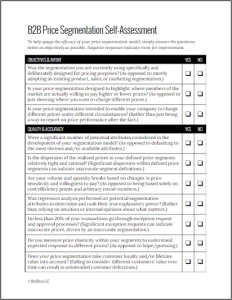
Simply answer the questions in this self-assessment (objectively) to gauge the likely quality, accuracy, and efficacy of your price segmentation model. You can assess overall quality, as well as pinpoint specific opportunities for improvement.