Clay Shirky, a consultant and professor who writes about technology, has been quoted as saying
“Institutions will try to preserve the problem to which they are the solution.”
It’s pretty easy to see this idea, which has become known as the Shirky Principle, within the American healthcare industry. Healthcare administration companies came into being in order to simplify the process of paying for medical care. But those companies developed an elaborate bureaucracy and complicated processes that made it really difficult to handle healthcare expenses without a healthcare administrator. And if anyone ever proposes new legislation that would actually simplify healthcare, they lobby against it hard.
The Shirky Principle in pricing
Something very similar can happen to pricing teams. Our discipline was created to solve operational headaches: endless discount requests, chaotic price lists, margin leakage, etc. When it becomes too much to handle, leadership creates a pricing function in order to simplify and control the pricing process.
But here’s the trap: Once you become the team that manages exceptions and approves discounts, that’s what you keep doing. Your day fills up with quote approvals and spreadsheet updates. You build better systems to process exceptions faster. You’ve become really good at managing the problem—but you’re not eliminating it.
In fact, you might be keeping it alive because solving those problems proves your value. Here are some examples of how we’ve seen this in practice:
- Streamlining discount approvals instead of asking why so many discounts are needed
- Maintaining complex price lists instead of simplifying pricing structure
- Responding to competitive pressure instead of building differentiated value
- Becoming experts at firefighting instead of fire prevention
All of those tasks seem like good things to do. But they ultimately perpetuate the problem you are supposed to be solving.
Breaking free of the Shirky Principle
So what should you do instead?
The breakthrough comes when pricing teams learn to recognize this pattern and then redirect their energy. Instead of managing problems better, they work to eliminate them.
That’s a difficult challenge. It requires focusing on root causes. It means reexamining your market positioning, value communication, and price architecture. And it necessitates a conscious effort to look for ways to stop doing any busywork that clogs up your days.
But when you do it correctly, this work reduces the need for constant intervention and frees up time for more strategic—and valuable—efforts.
We have several resources to help you make this switch:
- Earning Pricing a Seat at the Table discusses effective ways to leverage pricing data to drive and support high-level discussions, which in turn can elevate your team’s profile within the organization.
- From Tactical to Strategic Pricing outlines simple steps for reducing the firefighting and becoming more strategic.
- Developing a Winning Roadmap for Pricing offers practical advice for balancing day-to-day tactical activities with longer-term priorities.
It’s always a little disconcerting to feel like you are “working yourself out of a job.” But the good news is that within the pricing function there is always plenty more work that can be done. Don’t be afraid to let go of the less important stuff to make room for work that will have a bigger impact on your company’s success.
Earning Pricing a Seat At the Table

Pricing drives business outcomes — but rarely has a seat where those outcomes are decided. Move from executing handed-down plans to having a real hand in shaping them.
From Tactical to Strategic Pricing
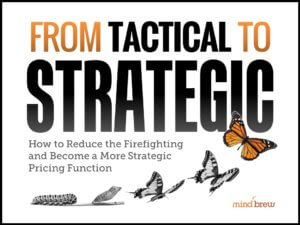
Some teams are so mired in tactical grunt work and daily firefights that they never make progress on strategic pursuits. How have other pricing teams transitioned into more strategic functions? What steps did they take?
Developing a Winning Roadmap for Pricing
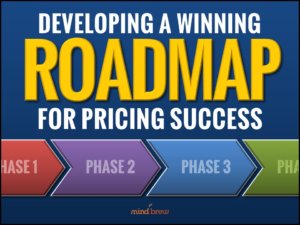
From our research, leading pricing functions go through key evolutionary phases in becoming more effective and strategic. In this 3-part training webinar, learn how to develop a roadmap that streamlines that evolution with a plan to be a more valuable and strategic function.