At the PricingBrew Journal, we’re big proponents of in-market tests, pilot programs, and proofs-of-concepts. In most commercial environments, executing something in a smaller way, learning what works and what doesn’t, and then rolling out more broadly is just good practice. After all, when we’re dealing with real markets, messy data, and a bunch of unpredictable humans, tiptoeing our way into bigger changes is a sensible approach.
Recently, however, one of our subscribing teams had some great questions:
“Does everything we want to change or improve really have to be tested or piloted? Aren’t some things just self-evident and obviously better?”
The honest answers are no, not everything needs to be tested or piloted…and yes, some things are quite obviously better.
While we can almost always design a pilot program of some kind, there are certainly situations where a formal test-and-control study just isn’t feasible. And in many cases, the logic and reasoning behind a change is strong enough to function as the proof…if A plus B equals C, then C minus B has to equal A…or, if X and Y happen, then Z is the most likely result to follow.
Now, this doesn’t mean that we’re trying to sidestep rigor or we’re resorting to guesswork. It just means that the conclusions flow directly from the underlying causal mechanics:
- If we tighten up our segmentation criteria and fences, price dispersion will almost certainly narrow.
- If we improve our in-market pricing guidance to cover more deal types, exception flows are almost guaranteed to shrink.
- If we strip away pointless approval layers…layers that have a 99.8% approval rate anyway…it can’t help but reduce deal cycle times.
- And if deal cycle times improve, the odds are pretty high that we’ll also see a bump in sales close rates.
Flowing from the mechanics, the conclusions are reasonable and logical. But all that being said, even when the reasoning and logic are rock solid, there are a couple of important considerations…
First off, we have to be thoughtful about how we go about explaining the underlying logic to others in our organizations. This is where otherwise smart pricing people can stumble, myself included. Because we’ve been grappling with the issues for months and we’ve worked through the logic in our own minds a hundred times or more, it’s easy to assume that it should all be blindingly obvious to everyone else. And then when we present it that way, it can come off as being condescending.
We always have to remember that the people we’re trying to persuade might be hearing things for the very first time. And they deserve a chance to arrive at the conclusions the way we did. So we need to lay out the assumptions. We need to explain the mechanics. We need to walk through the cause-and-effect chain. And we have to show why the probabilities strongly favor particular outcomes.
When the reasoning is sound, the logic itself can be very compelling and highly persuasive…without ever making others feel as though they’re being talked down to or behind the curve.
The second thing we need to consider is that even when the underlying logic is bulletproof and should be sufficient, we may still want to run a pilot program or proof-of-concept anyway. Not because our initiative actually needs more analytical validation or statistical proof, but because our organization needs more time or help getting comfortable with it.
You see, in-market tests and pilot programs are sometimes less about proving the concept and more about enabling adoption and utilization.
As we’ve highlighted before, a small pilot program can significantly reduce anxiety and perceived risks, while giving stakeholders a sense of ownership and involvement, and creating an early success story that people can grab onto. It can help lower the internal political temperature and reduce conflict by providing a less disruptive way to embrace change and start doing things differently.
In many cases, the organizational benefits are far more valuable than whatever additional analytical or technical insights a test or pilot program might provide. After all, the best solution in the world won’t actually solve anything unless and until it gets adopted and used by the organization.
So again…not everything we want to change or improve needs to be tested or piloted. And sometimes underlying logic is all the proof we need.
We just have to be clear-eyed about it and recognize that even when the logic and reasoning is irrefutable, we still need to explain it to others. And even though we don’t have to, we still might want to run a pilot to help with adoption.
Pricing Pilot Programs
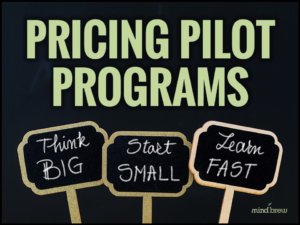
How do you get your company to accept new pricing approaches while maximizing your odd of success? In this session, learn how to leverage pilot programs and in-market trials to accelerate your progress.
"Better" Practices for Pricing Improvement
That lofty place of "best practice" can sometimes seem very far away. Fortunately, pricing has so much power that amazing results can be generated by just getting "better." In this webinar, learn how to adapt best practices in less than ideal situations.
Selling Your Pricing Initiative
Want to get your pricing initiative approved? In this on-demand webinar, learn how to structure and deliver your investment "case" in such a way that approval is almost a foregone conclusion.